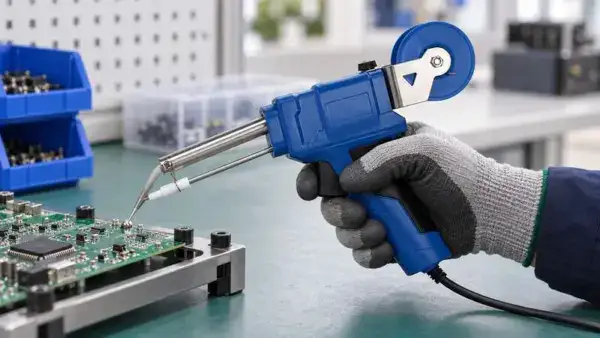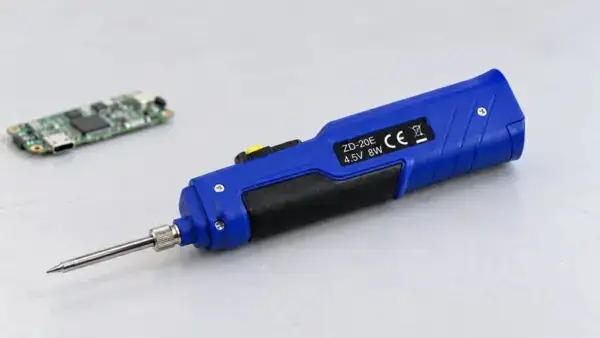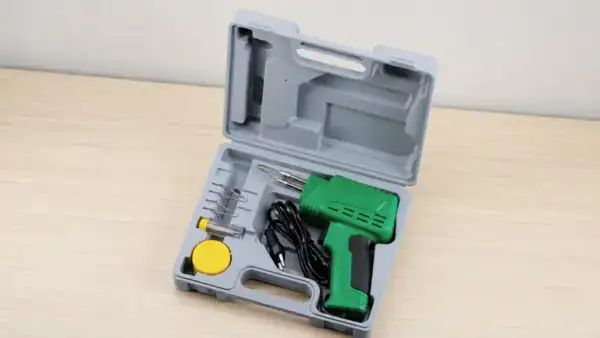
As PCBs become smaller and SMD components become more densely packed, can your repair bench still complete rework with sufficient speed and control?
Actual growth rates vary across markets and channels, but for repair providers working on mobile phones, computers, industrial control boards, telecommunications equipment, and consumer electronics, hot air equipment capable of handling SMD components reliably is gradually moving from an optional tool to a core bench setup.
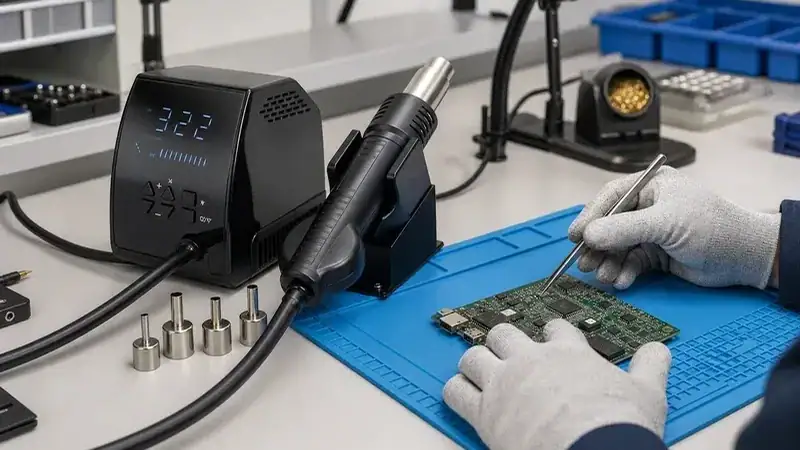
The value of a hot air rework station extends beyond delivering hot air. With adjustable temperature, controlled airflow, and suitable nozzles, it helps technicians concentrate heat more precisely when removing or installing surface-mount components, improving rework efficiency while reducing thermal impact on adjacent components and the PCB.
Accurate temperature control, adjustable airflow, and the right nozzle configuration are the foundation of stable SMD rework.
Why Are Hot Air Rework Stations Becoming More Important?
As electronic products become smaller and more highly integrated, PCBs continue to carry more SMD components. Conventional soldering irons remain suitable for touch-up soldering, wire connections, and localized work. However, when dealing with multi-pin ICs, connectors, shielding covers, or densely populated surface-mount components, a hot air rework station provides a more suitable heating method.
For repair providers and tool distributors, this means that a hot air rework station is not just a single tool. It is a category that can address a broad range of rework needs.
| Repair Requirement | Role of the Hot Air Rework Station | Value to the User |
|---|---|---|
| SMD IC Removal and Installation | Applies concentrated, even heat to the target area | Improves the efficiency of component removal and installation. |
| Localized PCB Rework | Works with airflow and temperature settings for localized treatment | Helps reduce unnecessary thermal exposure. |
| Connector and Port Repair | Suitable for multi-joint or larger surface-mount parts | Makes complex rework tasks more manageable. |
| Multi-Model Repair Service | Uses nozzles and settings to adapt to different components | One unit covers more work scenarios. |
| Tool Retail and Wholesale | Supports basic, digital, and combination product lines | Helps address different customer segments and price points. |
Hot Air Rework Stations and Conventional Soldering Irons: Complementary, Not Interchangeable
A hot air rework station does not make a conventional soldering iron obsolete. The two tools are suited to different tasks: an iron is better for point-to-point soldering and fine touch-up work, while a hot air station is better for SMD rework that requires uniform heating or involves multiple solder joints.
For repair shops and distributors, the more practical approach is not to choose one over the other, but to configure a complete rework-tool combination around the actual workflow.
| Tool Type | Best-Suited Tasks | Key Procurement Considerations |
|---|---|---|
| Temperature-Controlled Soldering Iron / Station | Touch-up soldering, wire connections, and fine solder-joint work | Temperature control, tips, heat-up speed, and handle comfort. |
| Hot Air Rework Station | SMD ICs, surface-mount components, and connector removal or installation | Temperature range, airflow, nozzles, automatic cooling, and ESD options. |
| Desoldering Station | Through-hole components and solder removal | Suction power, heating capability, filtration, and ease of cleaning. |
| Fume Extractor and ESD Accessories | Bench safety and protection for sensitive components | Filtration performance, electrostatic protection, and layout compatibility. |
Control Is What Ultimately Determines Rework Quality
Rework speed matters, but for professional users it must be built on control. Unstable temperatures, excessive airflow, or an unsuitable nozzle can increase the risk of component displacement, plastic deformation, or PCB heat exposure.
When selecting a hot air rework station, focus on three core capabilities:
- Stable Temperature ControlDifferent components, solders, and PCB constructions respond differently to heat. Adjustable, stable temperature control helps technicians establish more consistent procedures for each task.
- Continuously Adjustable AirflowAirflow determines the area over which heat is transferred. Smaller components require a more concentrated, gentler air stream, while larger components or multi-joint parts may require greater heating capacity. Adjustable airflow helps users balance efficiency with protection of nearby components.
- Suitable Nozzle ConfigurationNozzles are not merely accessories; they are a key part of the heating area and rework precision. When planning an assortment, distributors should also consider the availability of common nozzle types and replacements.
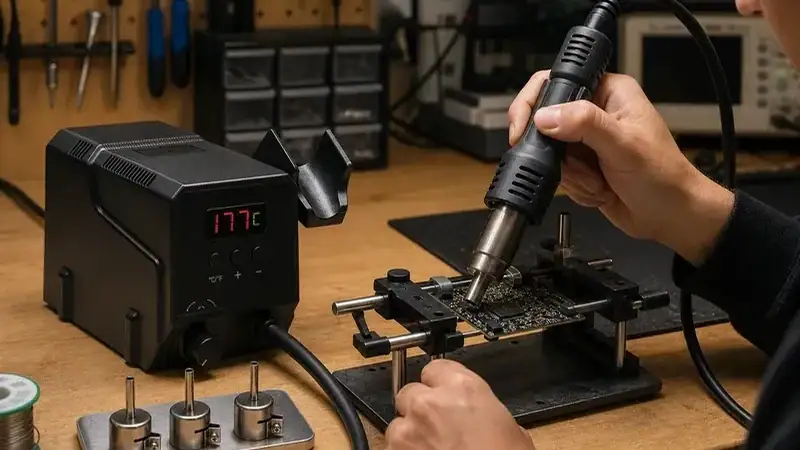
Matching nozzle size to airflow range directly affects rework accuracy and operating efficiency.
How Should Different Buyers Select Their Product Range?
Hot air rework stations should not be segmented by price alone. They should be tiered according to frequency of use, repair targets, and sales channels.
| Buyer Type | Recommended Configuration | Primary Focus |
|---|---|---|
| Small Repair Shops and Entry-Level Retailers | Basic digitally controlled hot air station | Ease of use, common nozzles, stable temperature control, and sensible pricing. |
| Mobile-Phone, Computer, and Consumer-Electronics Repair Providers | Professional digital hot air rework station | Precise temperature control, continuous airflow adjustment, fast heat-up, and low-noise performance. |
| PCB Rework Centers and Repair Chains | Two-in-one or three-in-one rework station | Combined hot air, soldering, and desoldering functions that save bench space. |
| Educational Institutions and Training Centers | Intuitive, durable, and easy-to-maintain models | Safety, clear operation, spare parts, and long-term maintenance support. |
| Importers and Brand Buyers | A scalable, customizable product range | Voltage, plugs, packaging, certifications, manuals, and OEM/ODM capability. |
What Should You Check Before Buying Hot Air Rework Stations in Bulk?
When sourcing hot air rework stations, do not compare appearance and quotations alone. Whether a unit can sell reliably and remain in long-term use depends on its technical specifications, spare-parts availability, and suitability for the target market.
- Confirm the temperature range and airflow-control capabilityThe temperature range should cover the requirements of the intended components and rework processes, while airflow should support continuous, stable adjustment for SMD components of different sizes and densities. The more stable these controls are, the easier it is for technicians to balance efficiency with component protection.
- Review nozzle configuration and ESD requirementsWhether common nozzles are included and replacement parts can be supplied over time directly affects the range of rework tasks the station can support. Professional environments handling sensitive electronic components should also confirm whether an ESD-safe version is required.
- Consider usability and durabilityAutomatic standby and automatic cooling help extend heating-element life and improve operating safety. Handle comfort, fan noise, and long-term operating stability directly affect the daily repair experience and after-sales risk.
- Confirm target-market compatibilityVoltage and plug type should meet local electrical standards; packaging should provide adequate transit protection; and appropriate manuals, warning labels, and compliance documents should be included to support market access and retail presentation.
- Do not overlook spare parts, after-sales support, and sample testingContinued availability of key parts such as heating elements, nozzles, and handles affects long-term maintenance costs. For bulk purchases, test samples first to confirm that equipment performance, packaging, and documentation genuinely meet the requirements of the target market and customer base before placing a formal order.
How Does Zhongdi Support a PCB Rework Product Line?
Zhongdi’s hot air SMD rework-station range is designed for precise, efficient SMD rework applications. Information on our website indicates a 100°C–500°C temperature-control range, as well as product configurations that include automatic standby, automatic cooling, brushless fans, and CE, GS, and RoHS compliance options.
For distributors looking to expand their rework range, Zhongdi also offers two-in-one and multifunction rework equipment. For example, the ZD-912 combines hot air and soldering-iron functions in one bench system for soldering and rework of SMD ICs and PCB components. It has a temperature range of 160°C–480°C, adjustable airflow from 3 to 24 L/min, and an ESD version option.
In addition, hot air rework stations can be combined with desoldering stations, fume extractors, ESD accessories, and PCB holders to create a more complete bench solution. For wholesalers and brand buyers, this modular product range can raise average order value while meeting professional users’ preference for one-stop sourcing.
Consistent quality inspection, accessory configuration, and packaging options are important elements in a bulk-purchase decision.
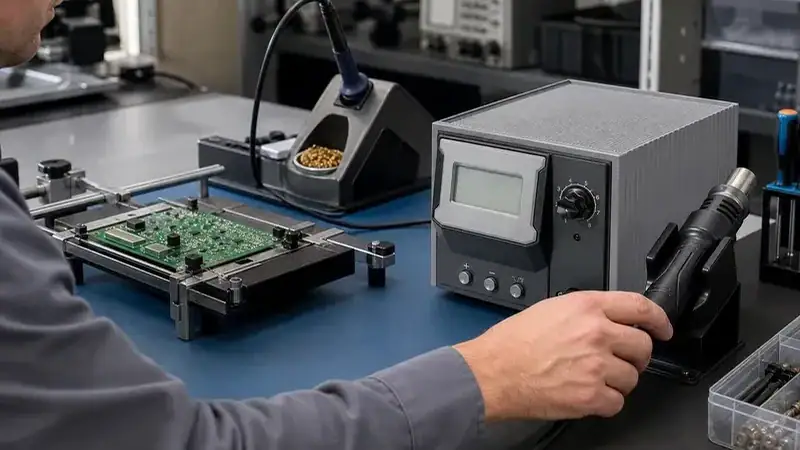
From a Single Tool to a Complete Rework Solution
Hot air rework stations are gaining attention not only because they can handle SMD components, but because they make repair work more controlled, more efficient, and easier to standardize.
For repair providers, they strengthen the ability to handle complex rework. For retailers and distributors, they are a key category that can extend sales of soldering irons, desoldering equipment, fume extraction, and ESD accessories. For brand buyers, they are an important part of a complete PCB rework solution.
To explore hot air rework stations, two-in-one rework stations, nozzle configurations, ESD options, or OEM/ODM packaging for your market, submit your target market, voltage requirements, application scenarios, and expected order quantity to Zhongdi for more tailored product recommendations and quotations. Contact us.