For professional tool retailers, selecting a soldering iron manufacturer is not simply a matter of comparing prices. Price matters, but longer-term questions become far more important. Experienced retailers do not only ask, “How much does this product cost?” They ask, “Can this manufacturer reliably support my product program?” Here are the six areas that leading retailers should evaluate when selecting a soldering iron or soldering station manufacturer.
Soldering Iron Manufacturer Quality Control: How Retailers Verify Consistency
Retailers are not only concerned about whether one sample performs well. Their real concern is whether the approved sample, the first production batch, and future replenishment orders will all meet the same standard. That is why product evaluation should go beyond features and extend to quality systems and verifiable evidence.
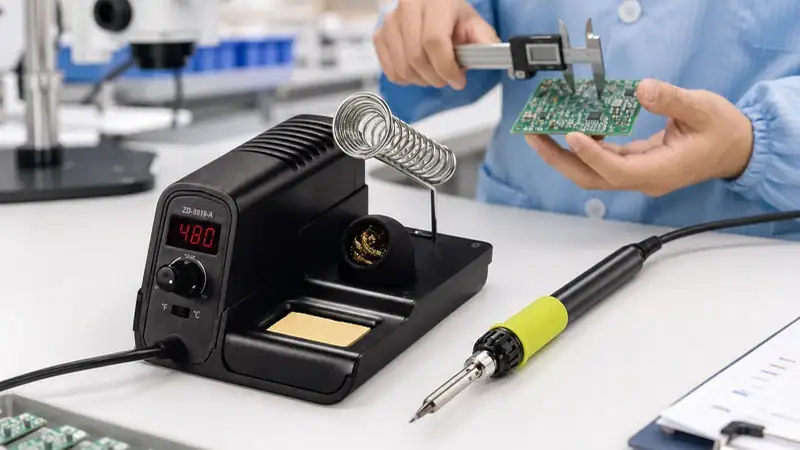
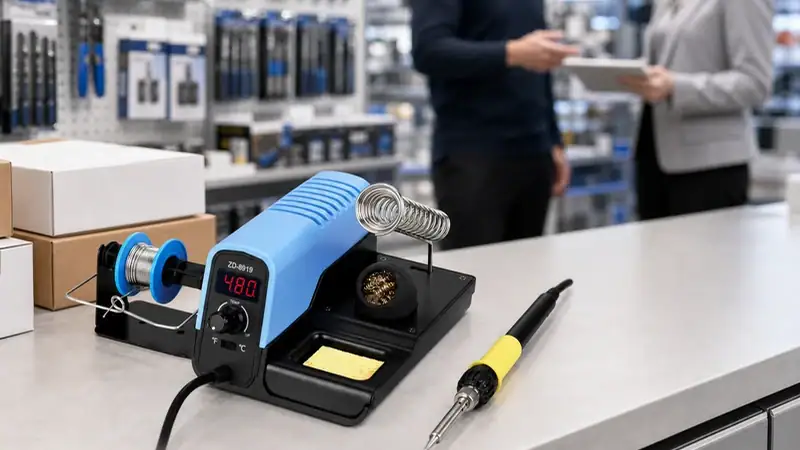
Take the ZHONGDI Industrial Soldering Station ZD-8919-A as an example. Its official product information highlights a PTC rapid heating element, an adjustable temperature range of 160–480°C, °C/°F conversion with an LED display, interchangeable tips, and included accessories such as a soldering iron stand, sponge, and cleaning ball.
These features help retailers define product positioning. However, before placing an order, buyers should still confirm production specifications, key components, inspection standards, and consistency between approved samples and mass production.
Retailers should ask manufacturers:
- How are key components and temperature-control performance inspected?
- How is consistency maintained between the approved sample and mass production?
- Can the manufacturer provide inspection records or test information for the target SKU?
- If a batch issue occurs, how will it be traced, corrected, and prevented from happening again?
The goal is not a “zero-defect” slogan. The goal is a stable, transparent, and executable quality-control process.
Soldering Iron Manufacturer Compliance: Certifications and Documents by Market
For retailers, certifications and compliance documents are not decorative items on a product page. They are prerequisites for market entry. Different countries and regions may require different voltage versions, plugs, labels, manuals, warning statements, and supporting documents.
ZHONGDI’s website presents CE, RoHS, TÜV-GS, EMC, REACH, SAA, ISO 9001, ISO 14001, and Amfori BSCI-related information. Retailers should treat this as a starting point for verification—not as an automatic confirmation that every model is approved for every market.
A practical approach is to create a “market–SKU–document” checklist:
| Checkpoint | What to Confirm |
|---|---|
| Target market | Which countries or regions will the product be sold in? |
| Electrical version | Do voltage, frequency, plug, and power cable match local requirements? |
| Product documentation | Are valid certification and test documents available for the specific SKU? |
| Retail labeling | Do barcode, warning text, language versions, and carton markings comply? |
| Document responsibility | Who updates, stores, and delivers the required documents? |
This prevents costly surprises when products are already in transit or ready for launch.
Soldering Iron Manufacturer Lead Time: What Retailers Need to Check
Retailers rarely purchase only once. The real challenge is managing new product launches, seasonal replenishment, promotion inventory, and out-of-stock recovery.
For that reason, lead-time evaluation should not focus only on a supplier’s quoted number of days. Retailers should assess whether the manufacturer can manage the complete process from sample approval to shipment.
A reliable manufacturer should be able to explain:
- What inputs are required before sample approval;
- When packaging, manuals, labels, and customization requirements must be finalized;
- At what point the production schedule officially begins;
- How key material and spare-part risks are managed;
- How inspection, packing, booking, and shipping documents are coordinated;
- How and when customers will be alerted if delays arise.
ZHONGDI presents a development flow that moves from customer requirements and concept design to tooling, test samples, testing, and mass production. This is particularly relevant for retailers evaluating new products, packaging upgrades, or private-label programs.
However, final lead time should always be confirmed in the quotation and purchase order for each project.
Retail-Ready Soldering Irons: Packaging, Labels, and Product Content
Even a well-performing product can create extra work if its packaging is not shelf-ready, product images are incomplete, retail labels cannot be implemented, or spare parts are difficult to manage.
For example, the Industrial Soldering Station ZD-8919 is available in different voltage versions and uses gift-box packaging. Its official product information also lists interchangeable tips, a spare soldering iron, and a spare heater. For retail channels, this means the product should not be managed as a main unit alone.
Before entering into a partnership, retailers should verify the following:
- Are clear images (white-background and lifestyle shots), specification sheets, and instruction manuals available?
- Are the gift boxes, outer cartons, internal packaging inserts, and retail labels suitable for the target sales channels?
- Is localization supported regarding barcodes, languages, power plugs, colors, or packaging designs?
- Do accessories and consumables have stable part numbers and an independent replenishment mechanism?
Soldering Iron Manufacturer After-Sales Support and Spare Parts
Retailers do not want a soldering iron to become an after-sales burden after it is sold.
The continued availability of replacement tips, heating elements, soldering irons, sponges, and related components directly affects customer satisfaction, return costs, and brand reputation.
That is why spare parts should be discussed together with the main unit—not only after a service issue occurs.
Retailers should request:
- A complete part-number list for main units and spare parts;
- Compatibility information by model and electrical version;
- Recommended spare-part stocking ratios and minimum order quantities;
- A troubleshooting and warranty-handling process;
- A clear communication process for missing parts, repairs, and technical support.
For private-label retailers, spare-part availability is often a prerequisite for expanding a product range. When service is under control, the business can confidently move from a trial SKU to a long-term category.
Soldering Iron Manufacturer OEM/ODM Support for Private Labels
The first order may involve only one or two existing models. Over time, however, leading retailers often introduce differentiated packaging, exclusive colors, bundled sets, upgraded manuals, or even customized product features.
At that point, a manufacturer’s value is no longer limited to production capacity. The real question is whether it can translate a retailer’s idea into a product that can be tested, manufactured, and delivered reliably.
ZHONGDI presents OEM/ODM support on relevant product pages and outlines a development process from customer requirements through to mass production.
For retailers building a private label, the following points should be confirmed early:
- Which changes are simple adjustments to an existing product?
- Which requests require new tooling, certification updates, or a new MOQ?
- What are the sample and production timelines for each change?
- Who approves packaging, labels, and product documents?
- How will design files and intellectual property be managed?
Soldering Iron Manufacturer Evaluation Checklist for Retailers
| Evaluation Area | Suggested Weight | Evidence to Collect |
|---|---|---|
| Product quality and consistency | 25% | Samples, inspection process, test records, batch-traceability information |
| Compliance and document management | 20% | Certification, testing, labeling, and market-specific documents |
| Lead time and replenishment reliability | 20% | Production schedule, material planning, communication process, delay contingency plan |
| Retail readiness | 15% | Packaging samples, barcode plan, product information, merchandising support |
| Spare parts and after-sales support | 10% | Parts list, compatibility details, replenishment process, technical support workflow |
| OEM/ODM collaboration | 10% | Customization process, development capability, sample and production plan |
Price may determine whether an order starts. These six capabilities determine whether a partnership lasts.
Choose a Soldering Iron Manufacturer That Supports Your Retail Supply Chain
When leading retailers select a soldering iron manufacturer, they are looking for a sustainable partnership built on consistent quality, predictable lead times, market-appropriate compliance documents, retail-ready packaging and content, available spare parts, and the ability to support brand growth.
Before requesting a quotation, use this checklist to define your requirements. Before confirming a supplier, validate its promises through samples, documents, project plans, and actual communication speed.
That way, you are not simply selecting a soldering iron supplier—you are building a more reliable retail supply chain.
Looking for a Reliable Soldering Iron Manufacturer? Partner with ZHONGDI
ZHONGDI supports importers, retailers, and private-label brands with soldering irons, soldering stations, spare parts, and OEM/ODM solutions. Contact our team to discuss product selection, pricing, packaging, certifications, and requirements for your target market. Contact us.